As part of our recent survey examining public opinion on the Ukraine crisis in NATO countries, we also looked at how Russians assessed the state of their own country and its place in the world. We found that while Russians are downbeat about their economy, they still strongly support President Vladimir Putin, have increasingly negative views of Western countries and leaders, and are nostalgic for the Soviet era.
Here are six charts that tell the story of the current mood in Russia:
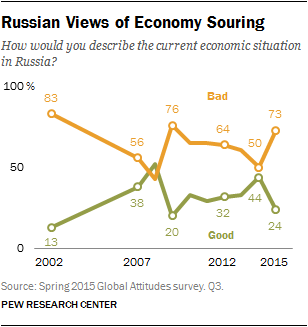 1Nearly three-quarters in Russia (73%) say that their economy is in bad shape. Only around a quarter (24%) say the Russian economy is doing well. Over the past year, the fall in the price of oil and Western sanctions have led to a 20 percentage point drop in positive economic sentiment, despite recent signs that the economic downturn might prove less severe than anticipated.
Asked what the cause of the economic downturn is, one-third of Russians point to Western sanctions, while another third blame falling oil prices. Only a quarter blame current government policies.
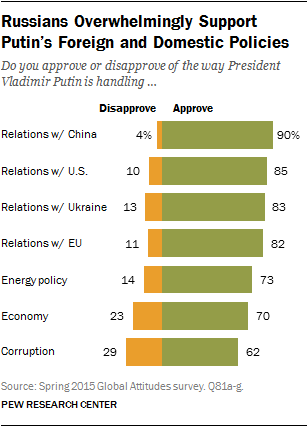 2Despite the negative economic mood in Russia, President Putin still receives overwhelming support from the public.On foreign relations, eight-in-ten or more approve of his dealings with China, the U.S., Ukraine and the European Union. In the domestic realm, overwhelming majorities support his energy policy (73%) and his handling of the economy (70%). His lowest rating is for his handling of corruption, but even here, 62% of the Russian public supports him.
Nearly nine-in-ten (88%) also express confidence in his ability to handle international affairs, including 66% who have a lot of confidence. This represents his highest foreign policy ratings since we began asking the question in 2003. Still, more people in 2015 than in 2014 say that Putin’s actions in Ukraine have led to a decline in Russia’s international image.
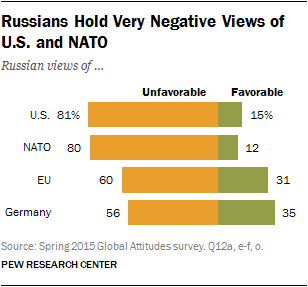 3Russians do not like the U.S. and other Western powers. Only 15% of Russians have a favorable view of the U.S., with 81% holding an unfavorable opinion. Similarly, only 12% of Russians have positive views of NATO. Even opinions of the EU (31% favorable) and Germany (35%) are at all-time lows. In fact, since 2011, positive views of Germany have fallen 43 percentage points. Similar drops in favorability also occurred in views of the U.S. (down 41 points), the EU (down 33) and NATO (down 25) since 2011.
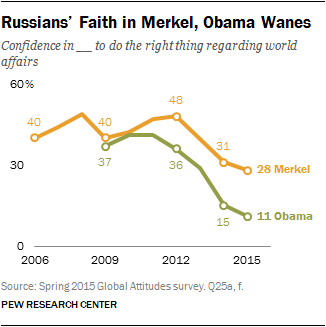 4Along with growing distaste for Western powers, Russians also have little faith in Western leaders. Only 28% of Russians have confidence in German Chancellor Angela Merkel to handle international affairs, and even fewer have confidence in President Barack Obama (11% confidence).
As recently as 2012, 48% of Russians had confidence in Merkel and 36% had confidence in Obama. However, distrust in an American president is not without precedent. The highest confidence rating from Russians for former President George W. Bush was 28% in 2005. And shortly after the Iraq War began, only 8% of Russians had confidence in President Bush.
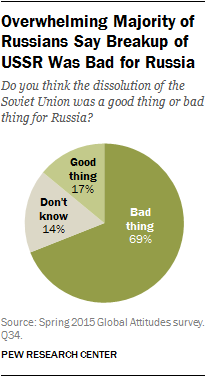 5Russians are nostalgic for the era of the Soviet Union. Nearly seven-in-ten Russians (69%) say the breakup of the Soviet Union was a bad thing for Russia. Just 17% say it was a good thing. Older Russians, those ages 50 and older, are much more likely to say that the breakup of the USSR was a bad thing (85%). Only 44% of young Russians say the same, though around a quarter (27%) have no opinion, probably owing to the fact that 18- to 29-year-olds were children or not even born when the Soviet Union collapsed in the early 1990s.
Additionally, about six-in-ten Russians (61%) agree with the statement that “there are parts of neighboring countries that really belong to us.” Only 29% disagree with such a statement. This sentiment has remained steady since 2002. However, in 1992, following the breakup of the Soviet Union, fewer than four-in-ten Russians believed that territories in other countries belonged to the Russian state, and still fewer believed this in 1991 (22%).
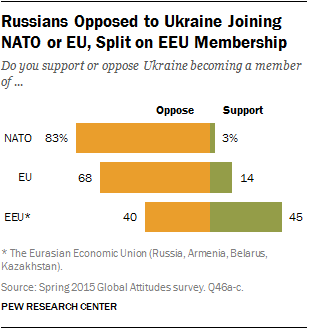 6Russians are split on Eurasian Economic Union membership for Ukraine, and they want the Donbas region of that country to secede. Only 45% of Russians say Ukraine should join the Eurasian Economic Union (EEU), a supranational body that consists of Russia, Armenia, Belarus and Kazakhstan, with Kyrgyzstan as an acceding state. Four-in-ten Russians are opposed to Ukraine joining the EEU. However, few Russians want Ukraine to join NATO (3% support) or the European Union (14%).
Meanwhile, 24% would like the self-declared republics of Luhans’k and Donets’k (currently part of Ukraine) to become part of Russia. A further 35% would like them to become independent states. About a third (32%) would like the Donbas region to remain part of Ukraine.
Jacob Poushter is an associate director focusing on global attitudes at Pew Research Center.